How Did Bayberries Get to Australia? Seven Little Trees and a Very Patient Experiment
Bayberries aren't native to Australia. Twenty-odd years ago, researchers set out to grow this southern Chinese summer fruit on our side of the world, and our orchard in Silvan was one of six trial sites. Here's the story, drawn from three government research reports.

Seven small trees on a grassy slope
Tucked into a government research report from 2010 is a photo you could easily flip past. A mown grass track runs up a slope, with tall gum trees behind it. Seven bushy little trees sit in a row on black weed mat. The caption says they're bayberry trees, grown from cuttings, about three years in the ground, near Silvan in Victoria.
That's our orchard, back when bayberries were brand new to it.
So how does a fruit from the other side of the world end up on a hillside in Melbourne's outer east? It took a lot of people, a lot of patience, and quite a few things going wrong.
We also made a five-minute video of the story:
A summer fruit, turned upside down
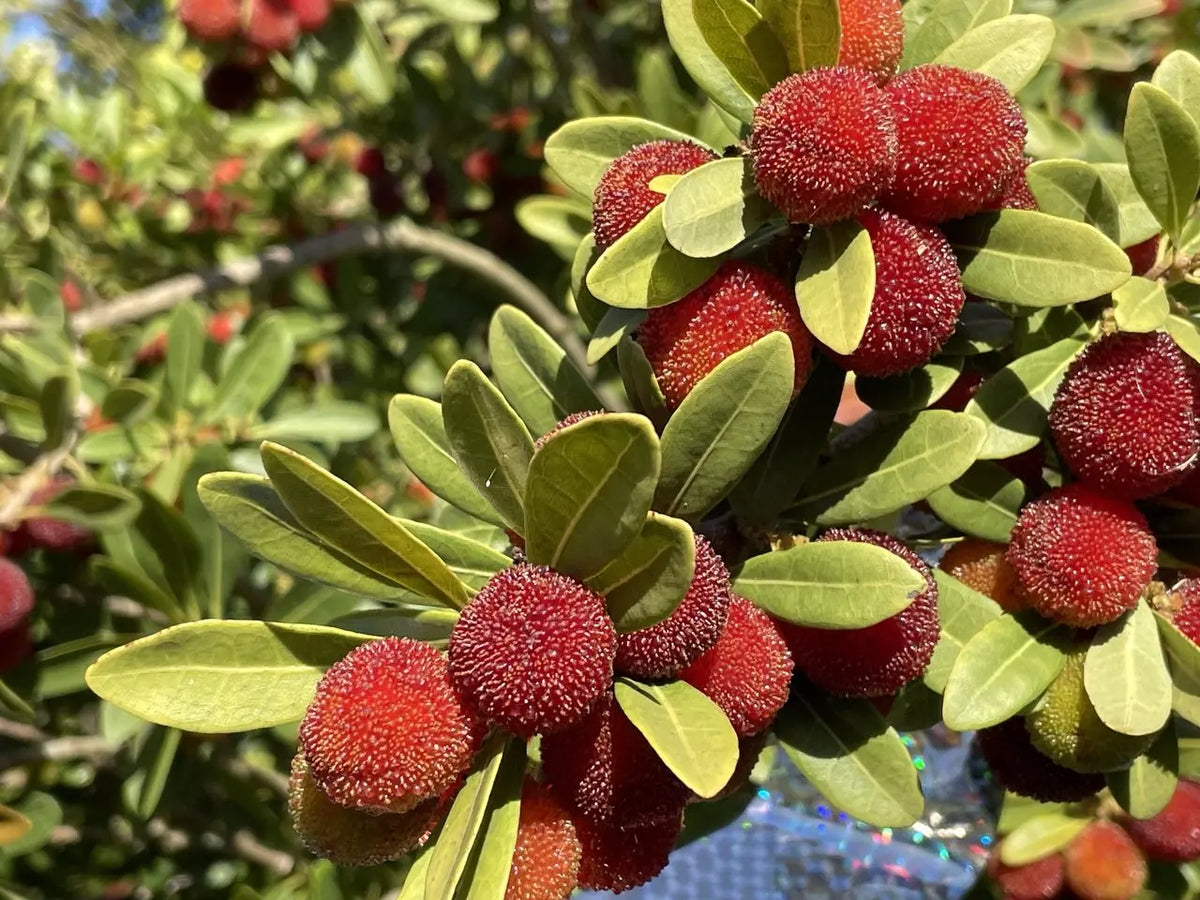
If you've never met a bayberry, picture something about the size of a cherry, deep red to almost black when ripe, with no skin at all, just tiny juicy bumps packed around a single stone. (Our guide What Are Bayberries? has the full picture.) It comes from south-east China, where people have grown it for thousands of years and where it ripens between May and July.
Now spin the globe. May to July is our winter. In June 2004, two Australian researchers travelled to Zhejiang province, deep in bayberry country, to see whether that simple flip of the seasons could give Australia a new summer fruit.
They came home with photos of orchards on poor hillside soil, of big trees left to grow as they pleased, of a packing shed where the fruit was being graded and boxed, and of growers selling straight from the roadside. One district they visited had been holding a bayberry festival every year since 1989. The early studies came to a clear conclusion: bayberries could be grown here, and were worth trying.
The parcels that didn't make it
Every new fruit crop needs good trees to start from, and that's where things got hard. The team asked growers and scientists in China, Japan and Florida for cuttings of their best varieties. The Chinese side was polite and generous with information, but not willing to share its trees. Japan and Florida did post budwood, the short lengths of branch used for grafting. Almost all of it was lost in transit or arrived too far gone to graft, and one parcel sat misplaced in quarantine for about a week. In the end a single line survived, and it wasn't one of the good ones.
Even tasting the fruit took some doing. In 2006, fresh bayberries were brought in from southern China via Hong Kong, and a small panel of volunteers had to taste them inside the quarantine facility at Brisbane Airport.
Picking winners from a crowd of seedlings
Plan B was a batch of young bayberry trees already in Australia, grown from seed. Brothers and sisters in one family don't all turn out the same, and neither do seedlings. One adviser reckoned that perhaps one seedling in thirty would come close to its good parent. There was no shortcut: grow them all, wait for fruit, taste and measure, then choose.
Cuttings from these young trees were planted in both Queensland and Victoria. At a research station near Nambour in Queensland, they fruited within two years, and a handful of standouts were picked out.
The hare and the tortoise
Queensland raced ahead. Victoria didn't. As of March 2010, the state had fifteen bayberry trees, including those seven in our orchard, and not one of them had flowered yet. With fruit coming so much faster up north, the next stage of the work moved to Queensland and northern New South Wales.
But the tortoise kept going. A few years later, the researchers recorded fruit on the older Victorian plantings too, including the cuttings in our orchard, ripening in early to mid January. In far north Queensland, the same fruit was ready in early November. Put the regions together, they noted, and Australia might one day have a bayberry season of ten weeks or more. Being slow, it turns out, had its uses.
Six sites, one of them ours
More than ten years ago, a government-funded bayberry research project chose six trial sites, and our orchard was one of them. Planted between July and September 2011, the sites ran down the east coast like a ruler laid north to south: Atherton, Yeppoon and Wamuran in Queensland, Corindi and Tumbarumba in New South Wales, and Silvan in Victoria. The idea was to watch how the same trees coped from the tropics all the way to the cool south.
Later on, fruit from the Silvan trial site went across the Tasman for a small tasting in New Zealand. People liked the flavour. Their one complaint was that the berries were a bit small.
So why aren't they at the shops?
The reports point to three reasons.
They're fragile. A bayberry stops ripening the moment it's picked, so it has to stay on the tree until it's fully ripe, and ripe ones don't keep. Stored at 1°C for 15 days, just 2.5% went bad. At 5°C, 67.5% did. A few degrees make all the difference.
They're hard to multiply. Good trees have to be copied by cuttings or grafting, and with cuttings taken from mature trees, fewer than half usually managed to grow roots.
And there just aren't many of them. For a fruit almost nobody here had heard of, wholesalers and food companies were cautious from the start.
And then
In the years since, our orchard has slowly grown.
Those seven little trees in the photo hadn't produced a single flower back then. These days, every summer, the orchard turns purple-black. When you stand under a tree eating a bayberry straight off the branch, you're tasting the end of a long story: a research trip to Zhejiang, budwood lost in the post, a tasting in an airport quarantine room, a crowd of seedlings grown and sorted one by one, and six trial sites strung down the coast. Our orchard is one small part of it.
Bring the kids, and come and taste one.
Questions people ask
Where can I try fresh bayberries in Melbourne?
Our orchard is in Silvan, about an hour's drive from the CBD, and we open for picking in bayberry season. Our guide to picking bayberries in Melbourne covers what to know before you visit.
When is the season?
Picking runs for about a month from mid to late December, and the opening date depends on the weather that year. People on our email list hear before anyone else, and you can leave your email here.
Are they OK for little kids?
Yes, with one tip: there's a single hard stone in the middle, so take it out before handing one to a little one.
Sources
The history in this article comes from three public reports by the Rural Industries Research and Development Corporation (RIRDC, now AgriFutures Australia).
- RIRDC Publication No. 05/174, Red Bayberry – a new and exciting crop for Australia? Travel Report (2005)
- RIRDC Publication No. 10/200, The Commercial Potential of Red Bayberry in Australia (2010)
- RIRDC Publication No. 14/050, Pilot production and sales of red bayberry in Australia (2014)
Archival photos in the video are from these three reports, © AgriFutures Australia.
Generated by Pude AI Manager, our in-house farm AI management system built on Anthropic's Claude, which runs our farm's production, operations and customer service – from weather and field records, plots and harvests, to orders, customers, email and scheduling. Every fact is traceable to our original records, and each article is reviewed by our family before publication.