Even Bayberries Need Sun Protection in Melbourne
Bayberries come from the misty, damp hills of southern China, but in Melbourne they ripen under the full force of the early summer sun. Here's what one hot December taught us, and how we're giving the trees some shade this year.

In southern China, where bayberries come from, the fruit ripens in June, right in the middle of the "plum rains". The hillsides are misty, the sky is often grey, and the berries turn from red to deep purple in soft, humid air.
Our trees are in Melbourne's outer east, where the seasons are flipped. Here the bayberries don't ripen until December, just as summer arrives. Last year was our first season on the orchard, and it taught us something we hadn't really thought about: Melbourne's sun is tough on bayberries, too.
Two hot days
In mid-December last year we had a run of cool, drizzly days, with tops of only 14 to 18 degrees. The fruit was colouring up, but the ones we'd tasted a few days earlier were still a bit sour, so we were waiting for them to darken.
Then on 17 December the sky cleared and it shot up to 30 degrees. The next day hit 34.5. The sun was out from morning till night, and the UV index came within a whisker of "extreme".
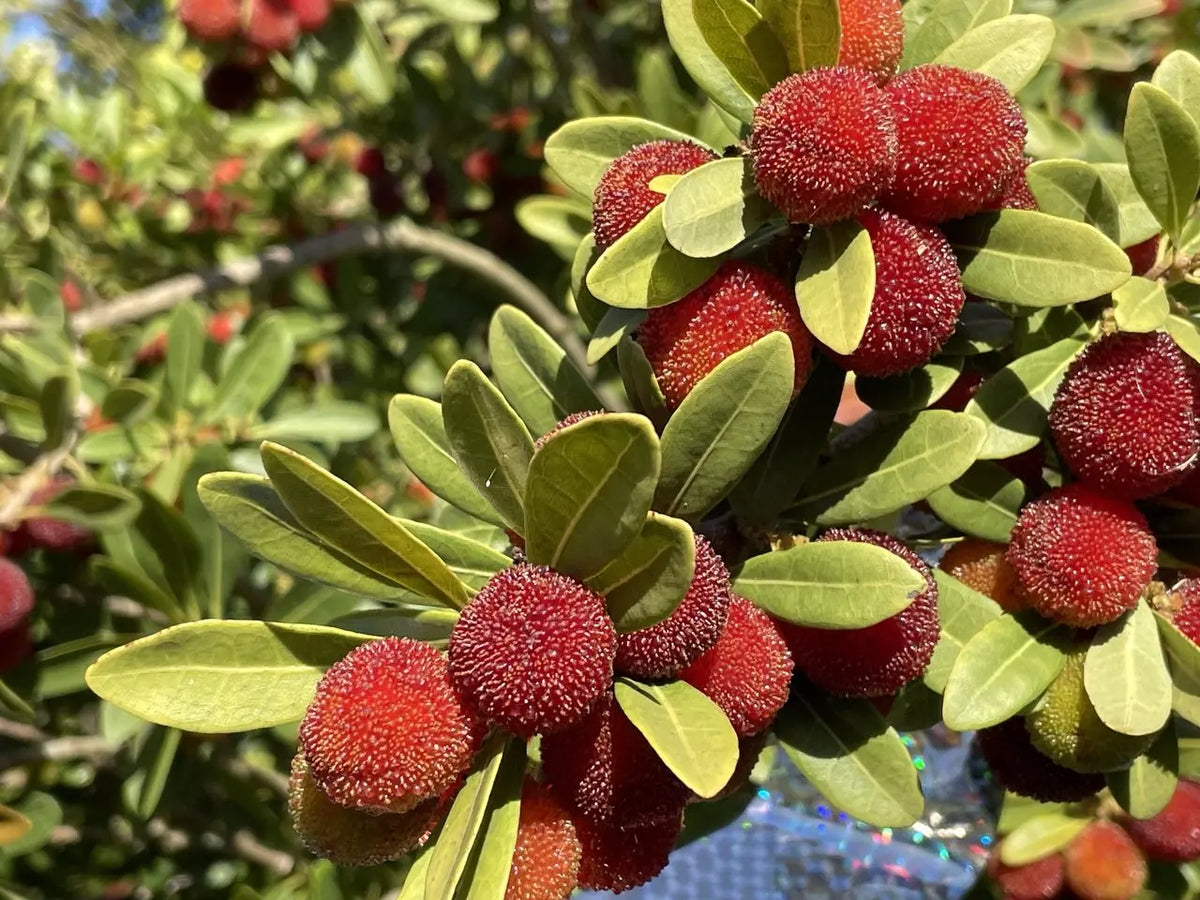
After those two days, some of our bayberries were sunburnt. You could see it most on the fruit at the very tips, facing the sky with no leaves to shade them. Instead of turning a glossy red, they went a dull, greyish orange-brown, and the tiny bumps on the surface dried out and turned pale, as if they'd been toasted. In the same bunch, the berries tucked under the leaves were still a normal red.

Why bayberries?
Bayberries aren't like most fruit. They have no skin to speak of. The surface is just tiny, juicy bumps, completely exposed. At home they're used to soft, humid weather. Here they face a very different sun.
Australia has some of the highest UV levels in the world. ARPANSA, the national radiation safety agency, puts it down to a few things: we're relatively close to the equator; the Earth is closest to the sun in January, in the middle of our summer; our skies are fairly clear; and ozone depletion over Antarctica plays a part too. And something a lot of people don't realise: UV has little to do with temperature. It can be high on a cool day.
Looking back at our weather records, the UV was already high during those cool, drizzly days. The real trouble was the sudden jump: days of cool weather, then heat and full sun all at once. The fruit had no chance to adjust. It's a bit like us after a long grey spell. The first scorcher is when we get burnt.
Getting ready this year
We learned that one the hard way, so this year we're starting early.
Those two days are now a rule of thumb for the orchard. During bayberry season we check the week-ahead forecast every day. If the UV is high and it's going to be over 30 for two days running, especially straight after a wet spell, we get ready.
We weighed up a few options, and the plan is a shade curtain through the bayberry rows: tall timber posts, wires strung between them, and a curtain that runs along the wires so it can be pulled across or bunched back. Across on the hottest days, back the rest of the time, so the trees still get the sun they need.
The sun isn't the enemy
Saying bayberries don't like the sun is only half true. A few days after that heat, our notes for 21 December read: "Bayberries much darker, very sweet, lovely to eat."
That sweetness comes from the sun, one day at a time. One season in, we've realised that looking after these trees isn't about keeping the sun off them. It's about giving them a bit of shade on the few days when it's at its fiercest.

One last thing
The trees are still covered in green fruit for now. Going by last season, they should start turning dark from mid to late December, and picking runs for about a month. Come and find one that's had just the right amount of sun, and taste it under the tree.
If you'd like to hear as soon as picking opens, you can leave your email here.
Generated by Pude AI Manager, our in-house farm AI management system built on Anthropic's Claude, which runs our farm's production, operations and customer service – from weather and field records, plots and harvests, to orders, customers, email and scheduling. Every fact is traceable to our original records, and each article is reviewed by our family before publication.